Solidarity Sunday: Building Trust in a World That Trusts No One
Nobody trusts institutions anymore.
Not corporations. Not government. Not healthcare. Not universities. Not the court system. Not the media. Simply saying, "You can trust us," doesn't change that.
Unions aren't automatically exempt.
Gallup found that Americans' confidence in major institutions averages just 28%, a historic low.
Organizing and Communicating Trust in This Kind of Environment
I remember exactly where I was on September 11. Most people my age do. It was a terrible event that stopped the country in its tracks.
We watched the same images on the same news networks, with journalists explaining what was known, what wasn't, and what it meant. They may not have gotten everything right, but there was still a recognizable institution between the event and the viewer. We experienced the tragedy together, through a shared frame.
But the young people we recruit are growing up in a completely different information environment, one that requires a completely different approach.
They see powerful people associate with predators and face no repercussions. They see public officials profit from their positions and political violence unfold in real time. School shootings, wars, and human tragedy arrive through the same device they use to play games, listen to music, watch their favorite videos, and talk to their friends.
Before one horror can settle, another replaces it.
There is no gatekeeper standing between them and any of it. They are left to sort through the horror, the commentary, the misinformation, and the performance on their own, and then try to decide who is telling the truth and who is simply trying to control the story.
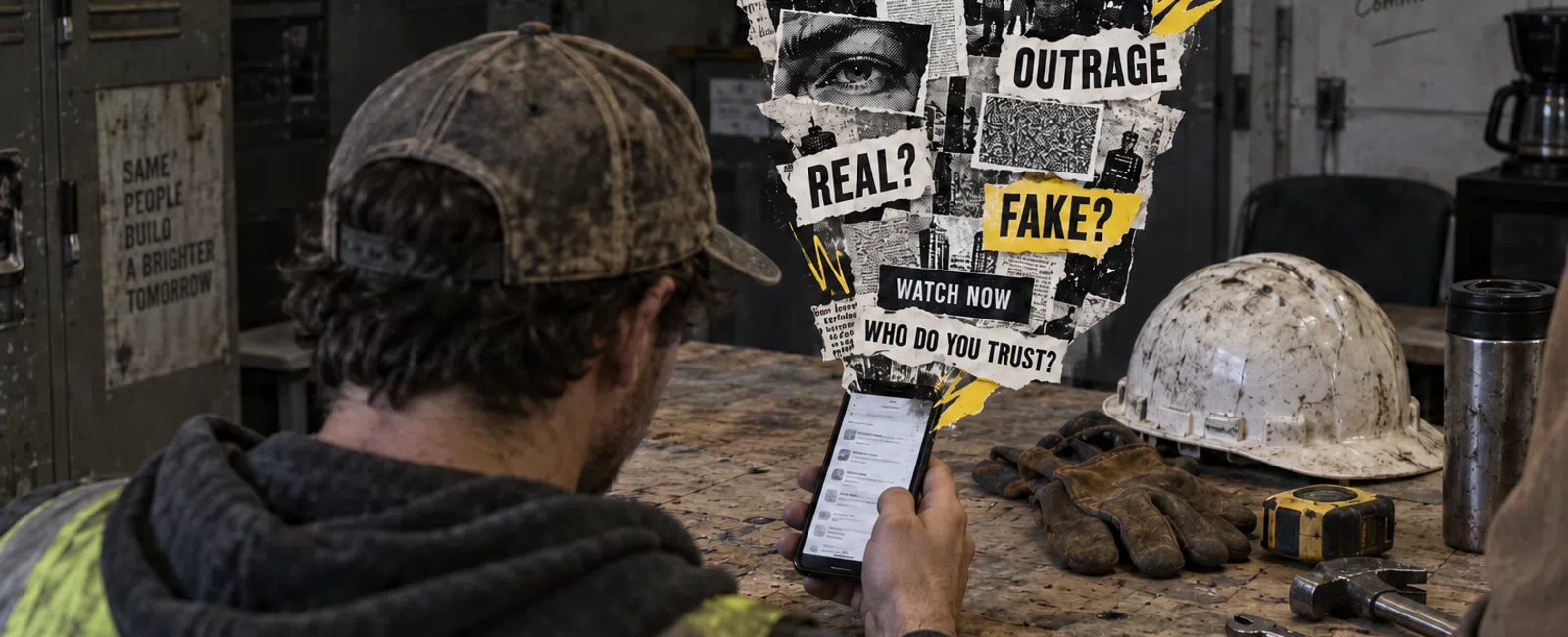
On top of all that, AI can now generate completely fabricated content that looks real.
So they learn to distrust almost everyone.
What looks like apathy on their part may actually be armor. Their dark humor, chaotic music, and dystopian memes may not mean they feel nothing. It may mean that they are feeling so much that detachment is their only way to cope.
That kind of constant exposure also makes empty messaging easier to recognize. When their feeds are filled with performance, outrage, and people trying to control how they are perceived, polished institutional language can feel like more of the same.
Yet young people haven't stopped wanting to believe in something. They've simply stopped trusting institutions that haven't earned their confidence.
They may not be looking for an organization that claims to be perfect, just one that is honest about what it is.
That gives local unions an extraordinary opportunity.
A local union can offer something increasingly real: useful work, skills people can call their own, experienced mentors, real relationships, and a community that shows up in person.
But the belonging we advertise has to be the belonging people actually experience. The message cannot be, "Here is what we want you to know about us."
It has to be, "Here is who we are. Here is what we do. Here is what you can expect from us."
And it has to be authentic.
That's where trust begins.
Trust is earned when someone gets a straight answer from the Hall, an organizer returns a phone call, leadership admits a mistake, and the local does what it said it would do. It is earned when communication reflects the actual character of the local instead of disguising its weaknesses behind polished language.
That is your brand.
It is what members say in the parking lot after the meeting. It is what an apprentice tells a friend. It is what a contractor believes about your workforce.
Good marketing cannot manufacture trust. It can only uncover what's already true, give it a clear voice, and make sure people see it. But the message has to be rooted in reality. Otherwise, people will recognize it as just another performance.
That is what we do at Union Up. We help local unions understand what they genuinely offer, communicate it honestly, and close the gap between how they want to be perceived and what their members actually experience.
Because people are still searching for something real.
Our job is to help local unions authentically communicate who they are, and to make sure that the people looking for that kind of organization can find you.